Hair · Dubai
Microneedling for Hair in Dubai
A minimally invasive scalp treatment that uses fine needles to stimulate hair follicle regeneration — encouraging thicker, fuller hair over time. Sessions are performed under DHA-licensed medical supervision at our Dubai clinic and are often paired with targeted serums or hair injectables to support results.
Medically reviewed byDr. Hassan HamdanGeneral Practitioner · DHA-licensedLast reviewed
- Duration
- 30–45 min
- Downtime
- Minimal — back to normal same day
- Course
- Short course, spaced over weeks
- Often paired with
- Serums or hair injectables
What Is Microneedling for Hair?
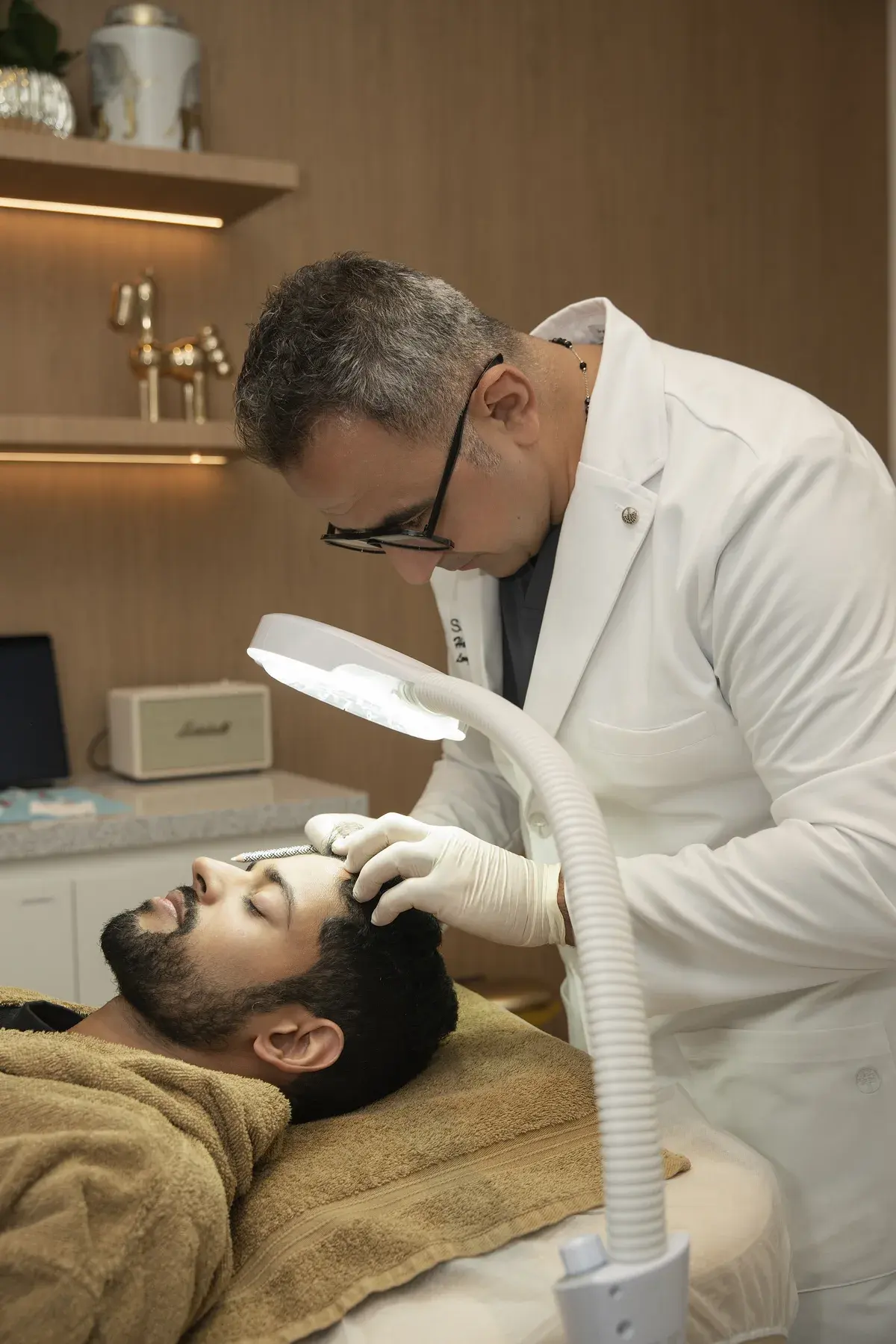
Microneedling for hair is a scalp treatment that uses fine needles to create controlled micro-channels in the scalp, stimulating the follicles and helping drive serums into the follicles to support hair growth and density.
Microneedling for hair uses advanced micro-needle technology to stimulate hair follicle regeneration and improve overall hair density. The fine needles create controlled micro-channels in the scalp, triggering the body’s natural healing response, supporting collagen production, increasing blood circulation and helping to revitalise dormant follicles.
Those same micro-channels also allow targeted serums to reach the follicles more directly, which is why microneedling is often combined with nourishing scalp serums, mesotherapy or hair injectables as part of a wider hair-restoration plan. The approach is matched to your scalp and goals rather than applied to a fixed formula.
At Shookra, sessions are carried out under doctor-led clinical protocols and administered by trained clinicians, with precise, comfortable treatment and minimal downtime. Your clinician assesses the scalp, confirms the pattern and cause of any thinning, and sets a cadence that gives the follicles time to respond between sessions.
What Does Scalp Microneedling Treat?
Scalp microneedling creates controlled micro-channels in the skin of the scalp. Two things follow: a wound-healing response that increases local growth factor activity around the follicle, and a temporary increase in how well topical treatments penetrate rather than sitting on the surface. The second is why it is most often used as a delivery step rather than a standalone treatment.
It is used for early thinning and reduced density, and for supporting the scalp environment alongside other hair loss treatment — frequently paired with PRP or with prescribed topicals selected by your physician.
The honest framing is the same one we apply to all hair work: hair loss is a symptom, not a diagnosis. Microneedling does nothing for a shed driven by low iron, a thyroid problem or a nutritional gap, and a scalp protocol applied to the wrong cause is effort wasted. Diagnosis comes first, every time.
Who Is Microneedling for Hair For?
Microneedling for hair can help with a range of common scalp and hair concerns — thinning hair and early hair loss, a receding hairline or diffuse density loss, slow or stalled growth, weak follicles, and a scalp with poor circulation or dull, lifeless hair. It is also used to support follicle strength and scalp health alongside other hair treatments.
Because microneedling works best as a short course paired with the right serums, your clinician confirms suitability at consultation, identifies the likely cause of your hair concern, and will review any scalp conditions, medications or recent treatments before starting.
- Thinning hair and early hair loss
- Receding hairline and reduced density
- Slow or stalled hair growth
- Weak follicles and dull, lifeless hair
- Scalp health and poor circulation
- Recovery and follicle support between treatments
Who it’s not for
A few situations mean it’s better to wait, or to choose a different treatment:
- An active scalp infection, inflammation or broken skin in the treatment area
- Pregnancy or breastfeeding
- A bleeding disorder or use of anticoagulant (blood-thinning) medication
- Certain scalp conditions, such as active psoriasis or eczema on the scalp
This isn’t exhaustive, and none of it rules you out on its own — your clinician confirms suitability at consultation.
What to Expect from Microneedling for Hair
- 01
Consult & assess
Your scalp and hair-loss concerns are assessed and a microneedling plan is tailored to you, including whether serums or hair injectables are added to support results.
- 02
Prepare & cleanse
The scalp is cleansed and prepared so the treatment can work evenly across the target areas. A topical comfort measure may be applied where appropriate.
- 03
Treat & aftercare
Microneedling is administered with precision across the treatment area to stimulate the follicles, and any chosen serum is worked in. You'll receive tailored aftercare to maintain results and support scalp health.
Hair Microneedling Results: How Long They Take
Hair works on a slow biological clock, and nothing changes that. A course is usually spaced three to four weeks apart, with reduced shedding often the first thing noticed at around two to three months and any change in density visible from roughly four to six months. Response varies considerably between people and depends heavily on the underlying cause and how early it was caught. No hair treatment guarantees regrowth.
- First 24 hours
- Mild redness and scalp sensitivity, which settles quickly. Hair washing and products are paused briefly per your aftercare.
- Months 2–3
- Reduced shedding is typically the first sign of response — noticed in the shower and on the pillow before it is visible in the mirror.
- Months 4–6
- Any change in density becomes visible. Standardised photos are essential here; day-to-day perception is unreliable with hair.
- Ongoing
- Maintenance sessions and continued treatment of the underlying driver. Stopping usually means the original pattern resumes.
Meet Your Practitioner
On Microneedling for Hair
Microneedling rarely does its best work alone. I treat it as a delivery step as much as a stimulating one — the micro-channels let a well-chosen serum reach the follicle, so I usually plan it as a short course alongside the right topical or injectable support. Before any of that, I want to understand why the hair is thinning; pattern and cause shape the plan far more than the device does, and they tell us how realistic a result to expect.
 Dr. Hassan HamdanGeneral Practitioner · DHA-licensed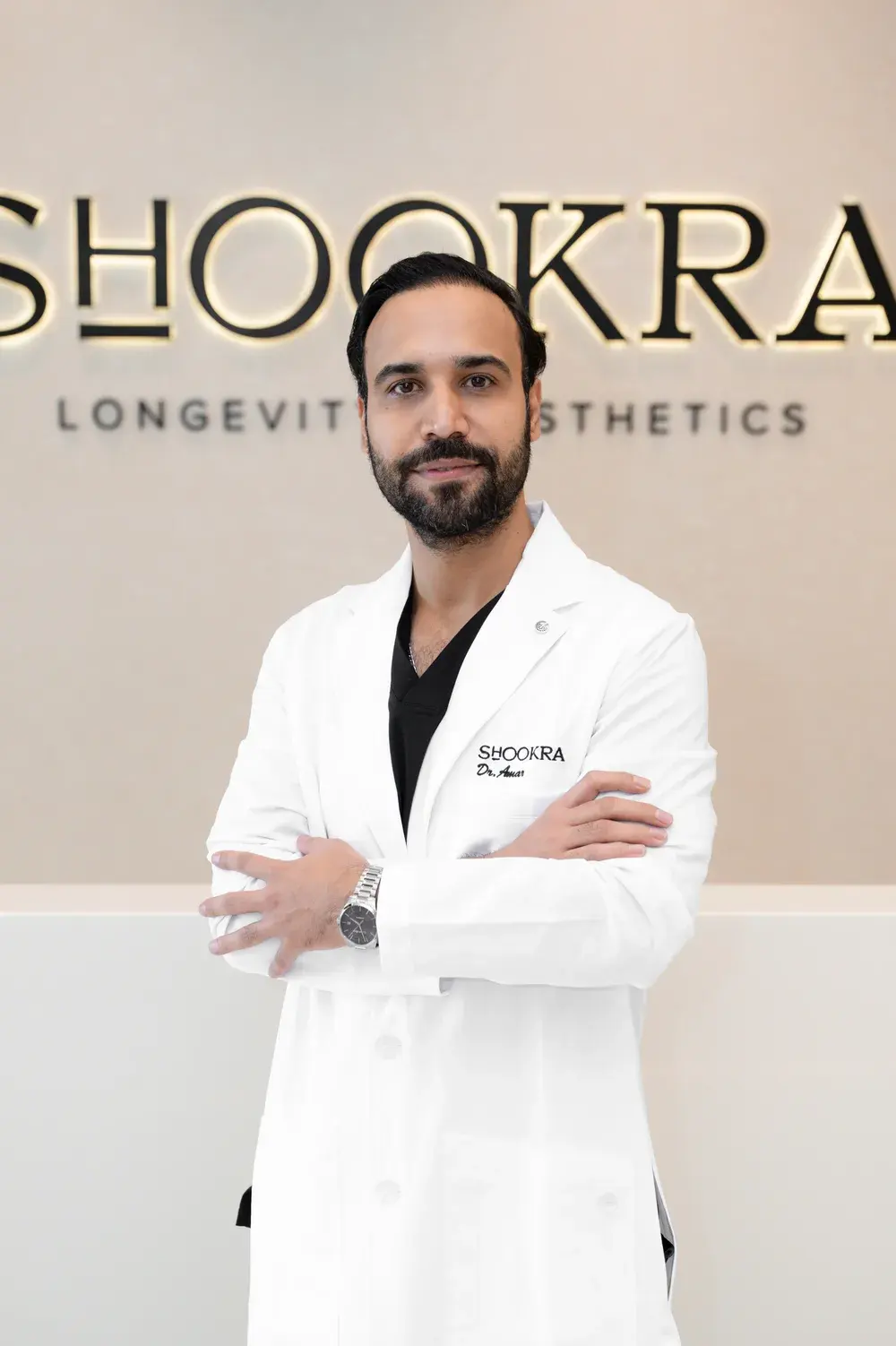
Surgical hair restoration
Dr. Amar Helali
Hair Transplant Physician · DHA-licensed
Dr. Amar Helali is a DHA-licensed physician whose practice centres on hair transplantation and aesthetic medicine. He holds an MD from Ahvaz Jundishapour University of Medical Sciences and certification in hair transplantation and facial aesthetics, and has practised in Dubai since 2022 — the last two years focused on hair restoration. He is published in peer-reviewed clinical research, and consults in Arabic, Persian and English.
- Qualification
- MD — Ahvaz Jundishapour University of Medical Sciences
- Licence
- DHA-licensed, practising in Dubai since 2022
- Certification
- Hair transplantation · Master of Facial Aesthetics
- Languages
- Arabic · Persian · English
Why Choose Shookra for Microneedling for Hair
 01
01Physician-led
Every protocol is planned and supervised by a DHA-licensed doctor.
 02
02Measured, then treated
We read your skin before we treat it, so the plan fits you — not a template.
 03
03Managed over time
Your care is tracked and adjusted as part of one practice, not one-off visits.
 04
04Medical-grade
Clinical protocols and equipment, in a discreet Dubai clinic.
Microneedling for Hair Questions
01Is microneedling for hair safe?
02When will I see results?
03How many sessions will I need?
04Is there downtime after treatment?
05Is it combined with other hair treatments?
06What does microneedling for hair cost at Shookra?
07Does microneedling really regrow hair?
08Is microneedling worth it for hair loss?
09How is it different from PRP for hair?
010Does scalp microneedling hurt?
Related treatments
Journal
Related reading
Hair11 min read
Hair Transplant Recovery Timeline: What to Expect, Month by Month
What happens after a hair transplant, from crusts and shock loss to new growth and the final result, with Dubai aftercare tips and red flags to know.
Read article
Hair11 min read
Dubai's Hard Water: What It Can and Can't Do to Your Hair and Skin
Is Dubai's water behind your hair fall or dry skin? What hard water can and can't do, what more often drives shedding, and when to see a dermatologist.
Read article
Hair8 min read
Hair Shedding: How Much Is Normal, and When to Pay Attention
How much hair shedding is normal, how to tell shedding from hair loss, why it spikes in Dubai, how long it lasts and when a scalp assessment is worth booking.
Read article
Where we do it
Microneedling for Hair in Dubai
Dubai · Business Bay
ShookraRetail 3, 15, Northside, Business Bay, Dubai, UAE+971 50 320 4553Open Mon–Sun · 10:00–22:00
View on Google MapsDubai · Palm Jumeirah
ShookraAndaz Dubai The Palm, 3rd Floor, Palm Jumeirah Rd, Palm Jumeirah, Dubai, UAE+971 50 320 4553Open Mon–Sun · 10:00–22:00
View on Google MapsLicensed & Regulated
DHA-licensed. MOHAP-approved.
Every treatment is delivered at Shookra, a DHA-licensed medical facility in Dubai. Every physician and clinician on our team is DHA-licensed and works to clinical protocol. Our health communications are independently reviewed and approved by the UAE Ministry of Health & Prevention (MOHAP).
Shookra Polyclinic · DHA Facility Permit #3449309 · MOHAP Advertisement Licence T0UOE5NK-020526

Book a consultation
Book your Microneedling for Hair consultation.
Speak with our team on WhatsApp — we’ll talk through your goals, suitability and pricing.